Comparing rsinaica to aire.zmvm
Diego Valle-Jones
2026-06-03
Source:vignettes/articles/airezmvm_vs_rsinaica.Rmd
airezmvm_vs_rsinaica.RmdThis vignette compares air quality data retrieved via the
rsinaica package against data from the
aire.zmvm package. To ensure a fair comparison, we will
analyze Ozone (O3) levels from the Xalostoc station in Mexico
City for the same time period.
Load Required Packages
First, we load the necessary libraries for data manipulation, visualization, and API access:
## Auto-install required R packages
packs <- c("dplyr", "ggplot2", "lubridate", "aire.zmvm", "rsinaica")
load_pkg <- function(pkg) {
  suppressWarnings(require(pkg, character.only = TRUE))
}
success <- vapply(packs, load_pkg, logical(1))
missing <- packs[!success]
if (length(missing)) {
  install.packages(missing)
  vapply(missing, load_pkg, logical(1))
}
The hourly data from the aire.zmvm package generally use
the GMT+6 time zone (with no Daylight Saving Time). In contrast,
according to the stations_sinaica data.frame, data for the
Xalostoc station is recorded in local Mexico City time, which included
Daylight Saving Time in the summer it was collected. Please note that
each station submits its data to SINAICA using its preferred time zone,
and the reported time zone may occasionally be incorrect.
## 271 is the station_id of Xalostoc
stations_sinaica$timezone[stations_sinaica$station_id == 271]
#> [1] "Tiempo del centro, UTC-6 (UTC-5 en verano)"
Next, we download the data and ensure that values from both
aire.zmvm and rsinaica are in parts per
billion (ppb). Since rsinaica returns values in parts per
million (ppm), we multiply them by 1,000.
df_aire <- get_station_month_data("HORARIOS", "O3", 2017, 5) %>%
  filter(station_code == "XAL") %>%
  mutate(value_aire.zmvm = value)
## data from get_station_month_data is in GMT+6
df_aire$datetime <-  as.POSIXct(
  strptime(paste0(df_aire$date, " ", df_aire$hour),
           "%Y-%m-%d %H", tz = "Etc/GMT+6")
)
df_aire <- df_aire[, c("datetime", "value_aire.zmvm")]


## values from sinaica are in ppb and those from aire.zmvm in ppm
## Xalostoc station has an rsinaica station_id of 271
df_sinaica <- sinaica_station_data(271, "O3", "2017-05-01", "2017-05-31") %>%
  mutate(value = value * 1000) %>%
  mutate(value_sinaica = value) %>%
  mutate(date = as.Date(date))
## data from rsinaica is in the local Mexico City time zone
df_sinaica$datetime <-  as.POSIXct(
  strptime(paste0(df_sinaica$date, " ", df_sinaica$hour),
           "%Y-%m-%d %H", tz = "America/Mexico_City")
)
df_sinaica <- df_sinaica[, c("datetime", "value_sinaica")]

df <- full_join(df_aire, df_sinaica, by = c("datetime" = "datetime"))
The merged data is shown below:
| datetime | value_aire.zmvm | value_sinaica | |
|---|---|---|---|
| 5 | 2017-05-01 05:00:00 | 2 | 2 |
| 6 | 2017-05-01 06:00:00 | 2 | 2 |
| 7 | 2017-05-01 07:00:00 | 3 | 3 |
| 8 | 2017-05-01 08:00:00 | 5 | 5 |
| 9 | 2017-05-01 09:00:00 | 17 | 17 |
| 10 | 2017-05-01 10:00:00 | 55 | 55 |
The mean squared error is as follows:
mean((df$value_aire.zmvm - df$value_sinaica)^2, na.rm = TRUE)
#> [1] 22.01807
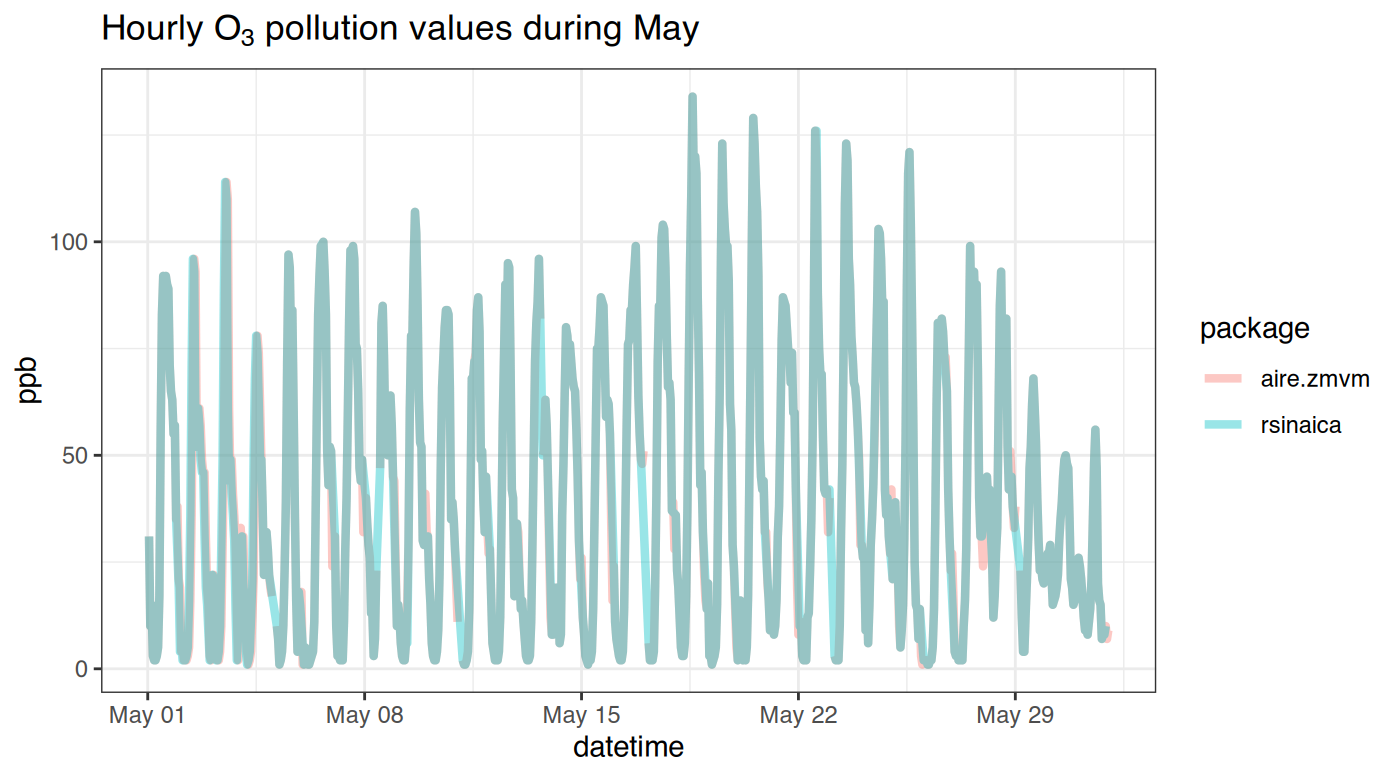
We can visually compare them with a plot. The values are extremely
similar, but the aire.zmvm data is slightly more accurate
since it comes directly from the source.
ggplot(df_aire, aes(datetime, value_aire.zmvm, color = "aire.zmvm")) +
  geom_line(size = 1.5, alpha = .4) +
  geom_line(data = df_sinaica, aes(datetime, value_sinaica, color = "rsinaica"),
            alpha = .4, size = 1.5) +
  xlab("datetime") +
  ylab("ppb") +
  scale_color_discrete("package") +
  ggtitle(expression(paste("Hourly ",
                           O[3],
                           " pollution values during May"))) +
  theme_bw()
#> Warning: Using `size` aesthetic for lines was deprecated in ggplot2 3.4.0.
#> ℹ Please use `linewidth` instead.
#> This warning is displayed once per session.
#> Call `lifecycle::last_lifecycle_warnings()` to see where this warning was
#> generated.